Choosing the right ERP platform is a strategic decision that shapes how efficiently your business operates, scales, and competes. Two popular solutions often compared in the ERP space are Odoo and EFACS E/8.
Both systems offer broad functionality across finance, operations, CRM, and manufacturing. However, they are built with different philosophies and strengths in mind.
In this guide, we compare Odoo and EFACS E/8 across functionality, scalability, deployment, and long-term value. This article should help you identify what solution would perform the best for your organisation.
What Is Odoo?
Odoo is a modular ERP platform with open-source roots. It offers two main editions:
- Community Edition – Free and open-source
- Enterprise Edition – Licensed version with expanded features
Odoo is built around a modular app structure. Businesses can start with core modules like Accounting or CRM and add functionality such as Inventory, Manufacturing, HR, or eCommerce as needed.
Strengths of Odoo
- Flexible, modular architecture
- Lower initial licensing costs
- Strong CRM and sales automation
- Modern user interface
- Suitable for small to mid-sized businesses
However, while Odoo’s flexibility is attractive, more complex environments, especially advanced manufacturing may require significant configuration or third party applications to match operational depth.
What Is EFACS E/8?
EFACS E/8 is a fully integrated ERP platform designed specifically for organisations with complex operational requirements — particularly in manufacturing, engineering, distribution, and field service.
Unlike modular systems that rely heavily on add-ons, EFACS E/8 provides deep operational functionality within a unified ERP environment.
Strengths of EFACS E/8
- Advanced manufacturing & MRP capabilities
- Integrated finance, CRM, production and service management
- Built-in workflow automation
- Strong support for engineer-to-order and discrete manufacturing
- Designed for structured scalability
EFACS E/8 is typically positioned for mid-market to larger businesses that need robust planning, scheduling, and cross-department integration.
Core Functional Comparison
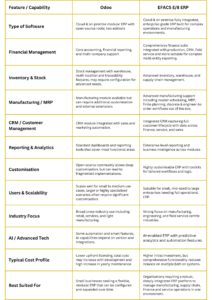
Financial Management
Both systems provide comprehensive accounting capabilities including:
- General ledger
- Accounts payable & receivable
- Multi-company support
- Financial reporting
Odoo delivers strong finance functionality, particularly in its Enterprise edition.
EFACS E/8, however, integrates finance deeply with production, inventory, service management and supply chain — allowing real-time operational and financial insight across departments.
For organisations needing consolidated reporting tied directly to production performance, EFACS offers a more embedded enterprise structure.
Manufacturing & MRP
This is where the differences become clearer.
Odoo Manufacturing
- BOM management
- Work orders
- Basic MRP
- Shop floor management (configurable)
For light manufacturing or growing businesses, Odoo’s tools may be sufficient. However, complex scheduling, finite capacity planning, or engineer-to-order workflows often require additional configuration.
EFACS E/8 Manufacturing
- Advanced MRP
- Finite scheduling
- Master production planning
- Engineer-to-order workflows
- Real-time production visibility
EFACS E/8 is purpose-built for structured manufacturing environments where precision planning and integration are critical.
For businesses with high production complexity, EFACS provides stronger out-of-the-box capability.
CRM & Customer Management
Odoo has a strong CRM module tightly integrated with sales and marketing automation, making it attractive for customer-focused organisations.
EFACS E/8 also includes CRM. However, its advantage lies in linking CRM directly to operational data, production schedules, service history, and financial records.
This integration can provide a true 360° enterprise wide view rather than a standalone sales perspective.
Deployment & Scalability
Both solutions offer:
- Cloud deployment
- On-premise options
- Browser-based accessibility
Odoo scales well for small to mid-sized businesses and can grow over time through additional modules.
EFACS E/8 is designed with structured scalability in mind, particularly for manufacturing and engineering businesses that anticipate growth in production complexity, supply chain expansion, or multi-site operations.
For organisations planning long-term operational scale, EFACS may provide a more stable enterprise foundation.
Total Cost of Ownership
Odoo
- Lower upfront licensing
- Modular pricing structure
- Costs can increase with customisation and third-party apps
EFACS E/8
- Higher initial investment
- More comprehensive functionality included
- Reduced reliance on bolt-on systems
While Odoo may appear more cost-effective at the start, businesses with complex requirements may find that long-term configuration and app dependencies increase total ownership costs.
EFACS’ deeper out-of-the-box functionality can reduce fragmentation and long-term integration challenges.
Pros & Cons Overview
Odoo – Pros
- Modular and flexible
- Lower initial entry cost
- Strong CRM and sales tools
- Modern interface
Odoo – Cons
- Advanced manufacturing may require customisation
- Third-party apps can increase complexity
- Scalability depends on configuration depth
EFACS E/8 – Pros
- Strong manufacturing & MRP capability
- Fully integrated enterprise structure
- Built-in workflow automation
- Designed for complex operational environments
EFACS E/8 – Cons
- Higher initial investment
- More structured implementation process
- May exceed the needs of very small businesses
Which ERP System Should You Choose?
Choose Odoo If:
- Your operations are light and not complex
- You require lower upfront costs
- CRM and sales functionality are primary priorities
Choose EFACS E/8 If:
- You operate in manufacturing, engineering or field service
- Advanced MRP and scheduling are critical
- You require deep integration across departments
- You are planning structured long-term growth