When selecting business management software, it’s essential to compare options that align with your organisation’s scale, complexity, and strategic goals. Two widely discussed solutions are Sage 50 and EFACS E/8 ERP . Each designed for different business needs and operational profiles.
In this article, we’ll highlight the key differences, strengths, and limitations of Sage and EFACS E/8 so you can decide which one suits your business environment better.
What Are Sage and EFACS E/8 ERP?
What Is Sage ?
Sage (sometimes branded as Sage 50cloud Accounts) is a well established accounting software package designed primarily for small and growing businesses. It provides essential accounting and financial management tools such as invoicing, bank reconciliation, inventory tracking, and multi-company budgeting. Pricing plans vary depending on features and number of users. It also includes AI-powered tools like document capture and report insights in the UK/Ireland version.
What Is EFACS E/8 ERP?
EFACS E/8 is a fully comprehensive ERP system built to support wider operational needs across manufacturing and field service organisations. It provides comprehensive modules covering finance, customer relationship management (CRM), production planning, field service management, workflow automation, and manufacturing planning logic. It’s a highly customisable and flexible ERP platform designed for mid-sized to larger organisations with complex operational requirements.
Core Functional Differences
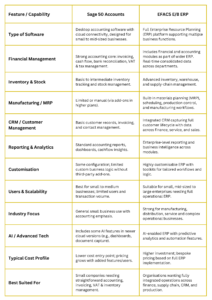
Scope of Functionality
Sage focuses mainly on accounting and financial management — ideal for small teams that want a reliable ledger, invoicing, stock control and basic reporting. It scales across user tiers (Pro, Premium, Quantum) with added capabilities as you upgrade.
In contrast, EFACS E/8 spans across the entire organisation, including CRM, field service, production scheduling (MRP), document and workflow management. This can be essential for complex operations where departments beyond finance need integrated tools. However, a full accounts package is also included.
Customisation and Flexibility
EFACS E/8’s customisation toolkit allows businesses to tailor modules and processes to their exact workflows. This is an advantage if you require bespoke manufacturing or process logic.
Sage, while extensible via add-ons and integrations, is inherently less flexible in altering core workflows or extending beyond financial functions without third-party tools.
Deployment and Accessibility
-
Sage is available as desktop software with optional cloud hosting (Sage 50cloud) to enable remote access and collaboration.
-
EFACS E/8 can be hosted on-premise or in the cloud, with browser-based access to support distributed teams and modern work patterns.
Reporting & Analytics
Reporting in Sage is strong for core financial tasks (like cashflow, P&L, and balance sheets) but becomes limited when you need cross departmental or multi entity analytics. Users sometimes resort to external tools (e.g., Excel) for advanced insights.
EFACS E/8 provides deeper enterprise level analytics across operations, production, and finance, enabling real-time dashboards that support decision-making for varied roles in the company from shop floor, all the way to the board room.
Scalability and Business Growth
Sage works well for small businesses and can support medium operations on its higher tiers, but it may struggle with:
-
Multi-entity consolidation
-
Complex supply chain workflows
-
Extensive product lifecycle and production scheduling
These often require additional systems or integrations.
EFACS E/8, by contrast, is purpose-built for organisations where ERP coverage across all functions. This includes materials planning, production, CRM, and service modules and also accounts. This is vital for growth and efficiency, particularly for companies that are experiencing growth and and require software to scale with them.
User Experience and Learning Curve
-
Sage is generally more basic and easier to learn for users familiar with accounting software due to its focused feature set and simple interface.
-
EFACS E/8, with its broad functionality, typically requires more training and implementation support, especially when customising workflows, but delivers more powerful tools once established.
Pros & Cons Summary
Sage: Pros
-
Accessible for small business accounting
-
Lower entry costs and predictable pricing tiers
-
Strong basic reporting and financial tools
-
Easy to implement and learn for finance teams
Sage: Cons
-
Limited enterprise features and automation
-
Basic ERP capabilities without extensive integrations
-
Can become restrictive as businesses scale
EFACS E/8: Pros
-
Comprehensive ERP covering finance, CRM, manufacturing, workflow
-
Customisable and flexible to fit complex operations
-
Real-time data across departments enhances visibility
EFACS E/8: Cons
-
Higher implementation and training overhead
-
Complexity may be excessive for small businesses (15 and below)
Which One Should You Choose?
Choose Sage If:
✔ You run a small to medium business with primary accounting needs
✔ You want quick setup and ease of use
✔ Your operations do not require deep ERP features like MRP, Production, or CRM
Choose EFACS E/8 If:
✔ You are a mid-sized or larger manufacturing/service enterprise
✔ You need a true ERP platform covering multiple core business functions
✔ Customisation, automation and cross-departmental data are business priorities